Mar 19, 2025
Part 1
I personally think that when it comes to game development, especially solo game development, nailing down your art style early in the process is extremely important. You can and should use placeholder art to speed up your development process but having a vision for what your game looks like is arguably the most important part of designing a game. Every time I have started a project previously I have ended up losing interest or giving up because I didn't feel that I (a non-artist) could properly execute an art style for that particular type of game that would be both possible and appealing.
For this reason, when I sat down last April to start prototyping my new tower defense game, the very first thing I considered was my art style. The mechanical theme of poker was already cemented at this point but I knew I wanted something that would be relatively easy for me to execute. I don't have much experience with 3D modelling, but my previous attempts to build games using pixel art have ended in me getting frustrated and giving up. Pixel art really isn't the beginner-friendly art style most make it out to be. You can cobble something together that looks bad pretty easily but creating beautiful pixel art is something that takes years of practice. At the same time I was pondering the beginnings of this project Balatro had been (and still is) blowing up majorly. I played the game a bunch and really loved the video poker sort of style but a pure video poker style isn't something that would work for my game outside of the UI so with that inspiration I decided to tackle "video poker" from a new angle.
I'm not sure where I had the epiphany but the art style I ended up settling on was a synth/retro/vaporwave-inspired color pallete and an abstract wireframe 3d style. I thought the synthwave colors would mesh well with video poker seeing as video poker itself was a product of the late '70s and early '80s where many of the synthesizers sampled by synthwave artists came from. This also gave me a good direction to look down for doing music down the line. (a discussion for another time) After this discovery, the first thing I did before writing a single line of code was to start drafting up some quick and dirty wireframe pieces. I wanted to see if I could come up with a pipeline for art to game that wouldn't be too time consuming while producing a decent and appealing result.
Thankfully because I posted about my progress to my friends in Discord I still have all of the files even though I formatted my computer recently. My first thought for tower design was to do something chess-inspired so the first piece of art I put together was this:
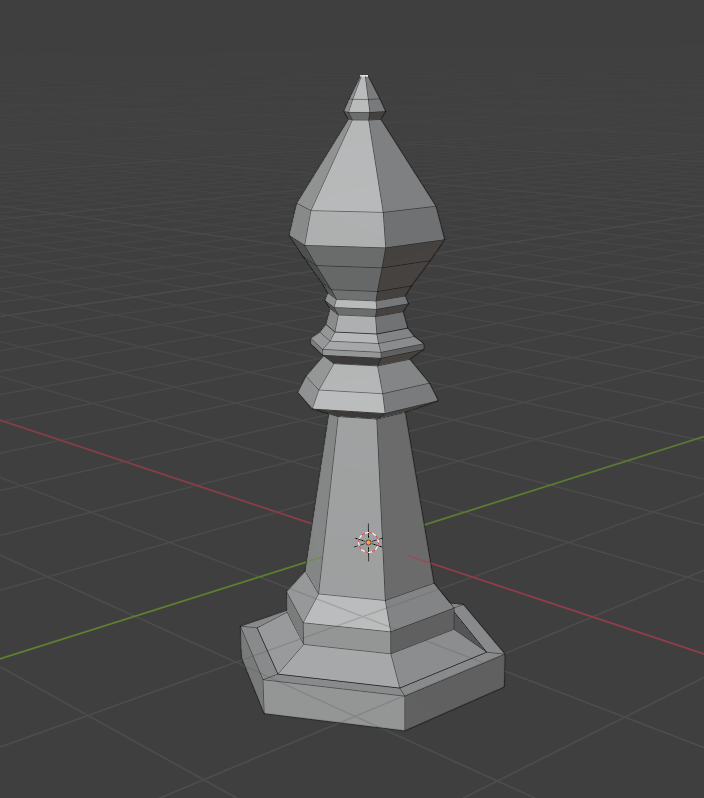
This ended up not being the direction I would go but it was good enough to figure out my rendering situation. I experimented for a while doing render tests in Godot, which would end up becoming my engine of choice for this project. I experimented with edge hightling and pixelization shaders to try and create something that felt 80s.
I generally liked how this looked but it was hard to get things to behave consistently, especially when using an orthogonal camera, which I knew wanted to do from the beginning. I ended up deciding that the best option was to use these abstract shapes but manually add a second material via blender's inset tool. This meant I could decide exactly which edges had the wireframe look and which didn't, without it being a major headache in terms of process. I also wasn't concerned about polygon count since my meshes were already so low-poly.
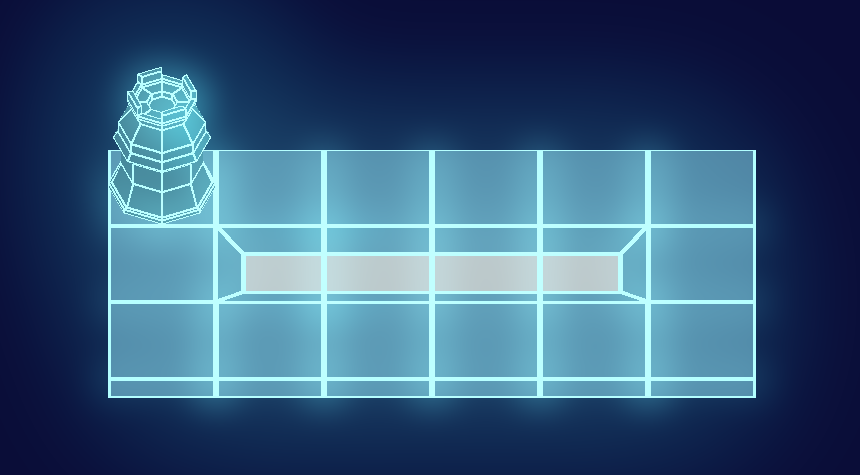
Here's an image from a little bit later in my process, showing a tower along with the first attempt at rendering the level (hasn't changed much since then.)
At the same time I was working out the 3D aspect of the art style I was also thinking about UI. Using the vaporwave color palette I threw together to figure out 3d, I drafted up some cards in Aseprite.
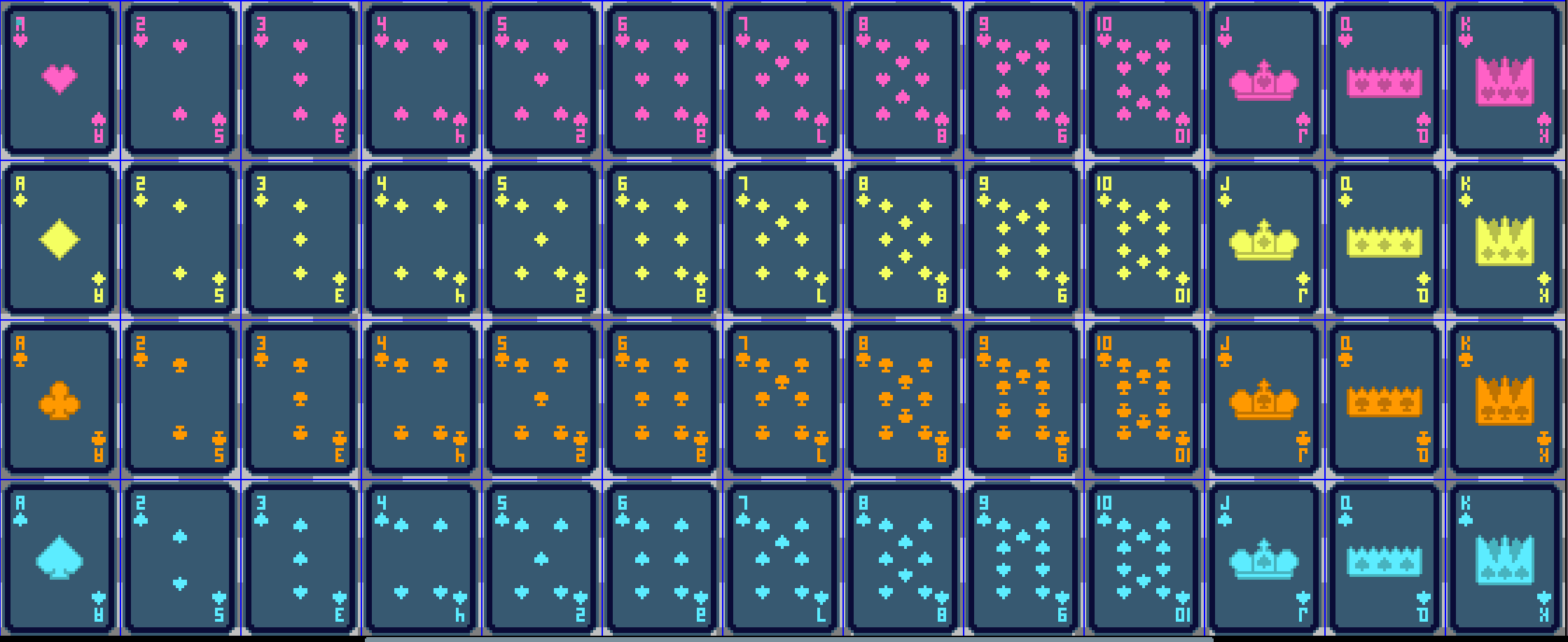
I personally thought these were a slam dunk. They took up minimal space on the screen but read very well at a distance. I had a standardized 5x5 pixel size for suit symbols which meant I had to make some sacrifices in terms of readability but my attempts at using bigger symbols ended up making cards that I thought looked much worse overall. These cards conveyed all the information I needed to and, despite their small size, read well on big and large screens alike. The colors here correspond to their elemental damage type, and while the types have switched around since I made this first draft, the basic design of the cards has not. I also threw together some basic textures for doing quick and dirty UI panels but honestly after comparing how my game looks to how 80s video poker machines look, I don't expect there to be much of a difference between what I have now and what the final product will look like.
So how does the game look at present? Well, have a look:
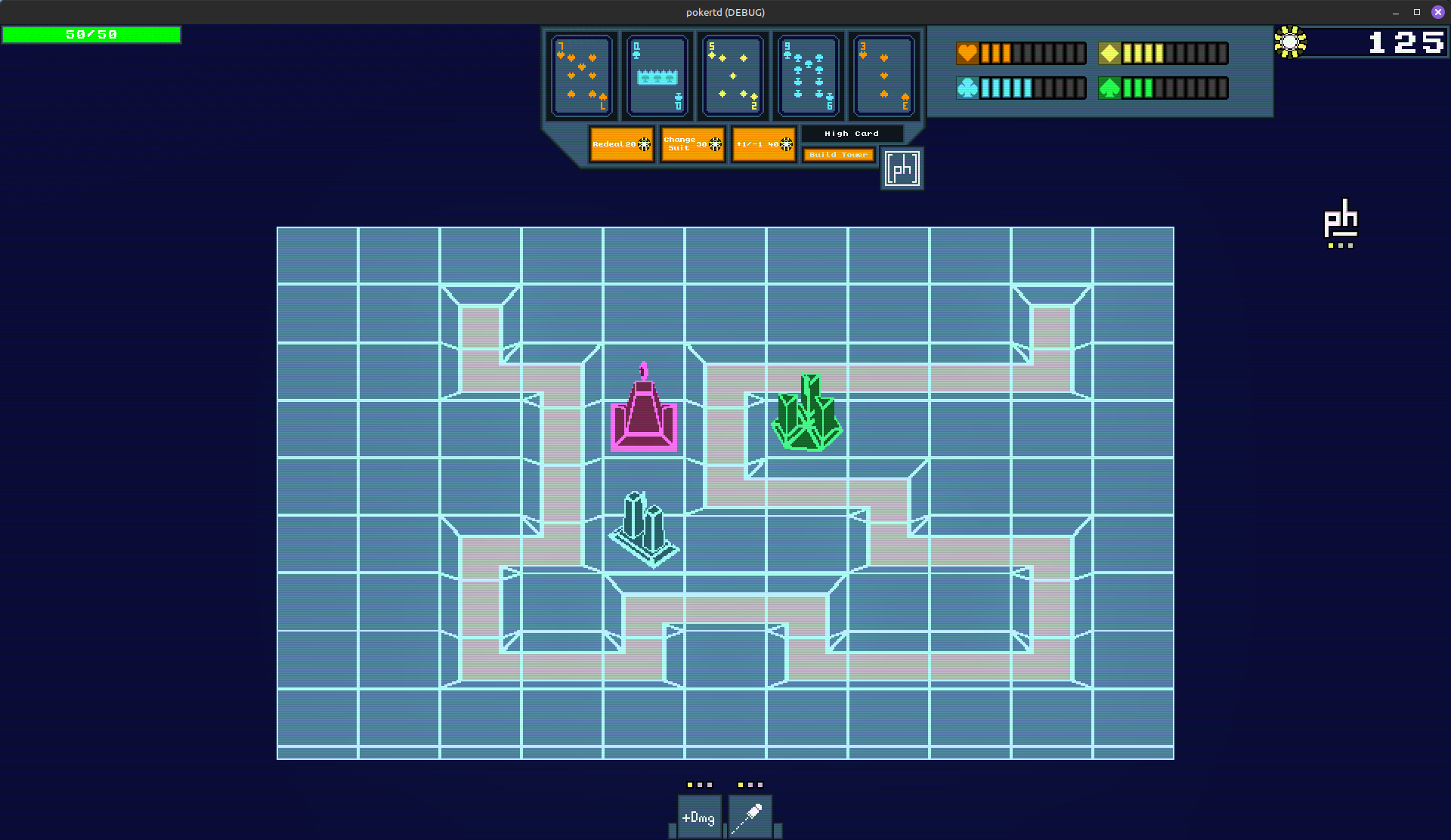
It's not the most impressive looking game ever but it definitely has a style. I'm proud of the work I've done but all I can think about these days is how much more I have to do to get a finished product. There's still a lot even in just this image and short clip that is unfinished or a placeholder.
Join me next time for... code? I guess code.
Mar 09, 2025
For a long time I've been trying to get more serious about Game Dev and coming up with a game project that is:
- Possible for me to develop solo with my current skills as a programmer (professional) and artist (bad)
- Interesting enough to keep me engaged with the process
- Actually marketable and fun
- Small enough in scope that I can make it in a reasonable timeframe
Pretty much every other concept I've come up with has serious problems with the latter point. The games that I most enjoy playing myself are strategy focused so I often find myself pointed in that direction when coming up with ideas. The problem with this is that systems-heavy strategy games are some of the most time consuming to develop so if I want to develop a game that holds my interest but won't take a decade I need to make a compromise.
Primary Inspiration
I spent a lot of time in middle and high school playing RTS games with my friends before League of Legends came onto the scene and grabbed our attention. Most of all I really enjoyed playing Starcraft I and II and Warcraft III. In the years before Starcraft II's release I was particularly grabbed by Warcraft 3 custom maps and especially tower defense maps. Some of the more popular tower defense maps from War3 like Legion TD and Element TD went on to eventually be made as full standalone game releases by passionate developers while others like Gem TD never saw a commercial release but were recreated in Starcraft II and Dota 2 (another Warcraft 3 custom map that eventually saw widespread commercial success).
One map that I have always found compelling was Poker TD. The concept was simple: every round you would construct 5 buildings, each one representing a card from a poker hand. Depending on the hand you were dealt, you would then combine the buildings into a single tower that would gain strength and abilities based on the rank of the poker hand as well as the highest card of the hand. You also gained gold from killing enemies that could be used to "tip" your dealer, giving you a higher chance of being dealt a strong hand. This one-note gameplay doesn't really hold up to modern standards but it was a fun map to play once or twice. If you're interested you can go here to see the map being played by WTii.
The map has seen a couple more recent iterations over the years including one released in the Starcraft II arcade that made use of a unit combining mechanic and mazing. There's also Poker Tower Defense by BelindaMakesGames which can be found here. I appreciated their modern take and thought the hand manipulation mechanics were cool but didn't like that you were forced to watch ads to get access to more uses of them (typical bad mobile game design). I also didn't find what little meta progression was present very compelling. They were obviously constrained by the timeframe of game jam development and mobile-centric design but I still found the concept interesting to play even years later.
A few years ago when I was thinking up ideas that I could make the poker-based tower defense concept kept coming back to my mind. I felt like I could make a good attempt using the basic poker mechanic while applying others from roguelite and autobattler games to make something well-rounded and fun. Tower defense as a genre is also complex enough to keep me engaged while avoiding some complexities of the types of games tower defense is derived from like RTS.
Other Inspirations
With the poker mechanic in mind I started thinking about what I could do to spice up the formula, so I drew on some of my favorite indie games of the past 5 years for inspiration. I really liked Die of Death Games' Rogue Tower (link here). The idea of applying roguelite mechanics to a Tower Defense, to my knowledge, hadn't really been tried up to that point and I thought it was a really solid first execution. I enjoyed the variety of strategies you could employ but found the meta-progression to be very front-loaded, with the upgrade tree that lets you choose upgrades more often being an order of magnitude more powerful than every other. I thought the mechanic for building the map as you went was cool in theory but in practice resulted in obnoxiously large maps that made waves take a really long time with lots of map space going unused by your towers.
On the autobattler end I really enjoyed SNKRX by a327ex. I loved the incredibly simple concept and thought that the autobattler synergies and upgrade system were really well designed. I've also taken some inspiration from Teamfight Tactics especially in building a modular upgrade system.
Addressing the Flaws
With the concept in mind I started brainstorming ways to make a well rounded game. Going all the way back to the original map, none of the takes made you care about the suits of the cards that you're playing, only the rank of the cards and the rank of the hands that the cards comprise. What I landed on was the idea of having "Suit Powers" which confer an ability to the tower that is themed after the object that the card suit represents. I realized that the suit power system might be confusing when you are being dealt hands that comprise cards from multiple suits so I settled on having meters that fill up whenever you "play" a card from the corresponding suit. Play 10 cards from a single suit and you get an upgrade for that suit that you can apply to a tower of your choice. I also realized the potential that suit powers had in adding to replayability so I brainstormed up a bunch of different suits based playing and tarot card suits from various world cultures as well as a few of my own ideas. The idea is that you would choose a deck "loadout" of 4 suits before each run/level. I also wanted a RPS-like damage system to encourage diverse loadouts so each suit has a damage type associated with it.
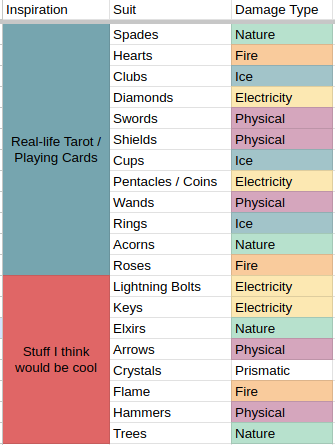
I thought the hand manipulation mechanics from BelindaMakesGames' Poker Tower Defense were great despite the mobile-centric design so I settled on tying these powers to a currency system that would also be used to purchase upgrades from a typical roguelike-esq shop. On the note of upgrades, I decided pretty early on that I wanted two different kinds of upgrades, modular upgrades that are applied to a specific tower and global upgrades that affect all towers, a subset of towers or some other aspect of gameplay. An upgrade is selected from 3 every round with more being available in the previously-mentioned shop. Both types of upgrades can be ranked up for a stronger effect. Each tower would have 3 "slots" for modular upgrades with a 4th special slot reserved for suit powers.
This all sounds like a lot, especially coming from the simple mechanics of the original inspiration but I think I've done a decent job so far of managing scope creep. At time of writing I've been working on the game for a little less than a year including some pretty massive periods of inacivity so we still have quite a ways to go but I hope you'll enjoy reading about my process.
Join me next time as I discuss finding an art style that I can execute with absolutely 0 talent as an artist.
Part 2